Setting the Work Envelope by Mechanical Stops
Mechanical stops set the absolute work envelope that physically limits where the Manipulator can move.
Both Joints #1 and #2 have threaded holes in positions corresponding to angles for the setting area. The positions of the mechanical stops (variable) set the work envelope. Install the bolts in the threaded holes corresponding to the angles to be set.
Joint #3 can be set to any length less than the maximum stroke.
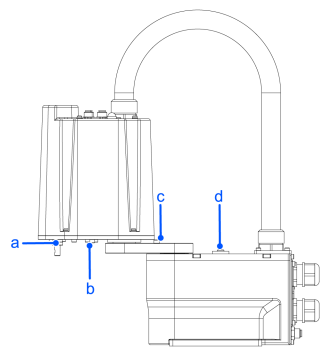
| Symbol | Description |
|---|---|
| a | Joint #3 mechanical stop (upper limit mechanical stop) *Do not change the position of the upper limit mechanical stop. |
| b | Joint #2 mechanical stop (adjustable) |
| c | Joint #2 mechanical stop (adjustable) |
| d | Joint #1 mechanical stop (adjustable) |
Setting the Mechanical Stops of Joints #1 and #2
Both Joints #1 and #2 have threaded holes in positions corresponding to angles for the setting area. The positions of the mechanical stops (variable) set the work envelope. Install the bolts in the threaded holes corresponding to the angles to be set.
Joint #1:
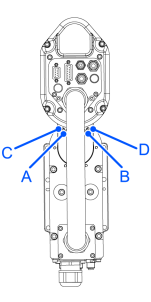
| Model | A | B | C | D |
|---|---|---|---|---|
| All | +125° | -125° | +120° | -120° |
Joint #2:
| GX1-C171 * | GX1-C221* |
|---|---|
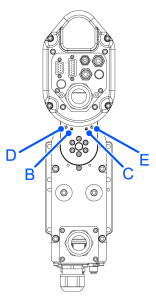 | 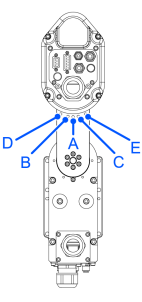 |
| Top | Top |
| Model | A | B * | C * | D | E | |
|---|---|---|---|---|---|---|
| 4-Axis specifications | GX1-C171S | - | +140° | -140° | +130° | -130° |
| GX1-C171C | - | +140° | -140° | +130° | -130° | |
| GX1-C221S | ±152 | +140° | -140° | +125° | -125° | |
| GX1-C221C | ±149 | +140° | -140° | +125° | -125° | |
| 3-Axis specifications | GX1-C171SZ | - | +135° | -135° | +125° | -125° |
| GX1-C221SZ | - | +135° | -135° | +120° | -120° | |
*Standard position of the mechanical stop
Turn off the Controller.
Install a hexagon socket head cap bolt into the threaded hole corresponding to the setting angle, and tighten it.
Joint Hexagon socket head cap bolts Pneumatic Tubes Recommended tightening torque Strength 1 M6 × 10 full thread 2 17.6 N·m (180 kgf·cm) ISO898-1 property class 10.9 or 12.9 equivalent 2 M5 × 10 full thread 2 9.8 N·m (100 kgf·cm) Turn on the Controller.
Set the pulse range corresponding to the new positions of the mechanical stops.
POINTS
Be sure to set the pulse range inside the positions of the mechanical stop range.
< Example: Setting Joint #1 to -120° to +120° and Joint #2 to -130° to +130° for the G1X-C171S>
Execute the following command in [Command Window].>JRANGE 1,-873814,6116694 ' Sets the pulse range of Joint #1 >JRANGE 2,-2366578,2366578 ' Sets the pulse range of Joint #2 >RANGE ' Confirms the setting value using the Range statement -873814, 6116694, -2366578, 2366578, -1092267 ,0, -393216, 393216Move the arm by hand until it touches the mechanical stops to check that nothing will hinder the arm motion during operation, such as by hitting peripheral equipment.
Operate the joint with the new settings at low speeds until it reaches the positions of the minimum and maximum values of the pulse range. Check that the arm does not hit any mechanical stops.
(Check the position of the mechanical stops and the motion range that were set.)
< Example: Setting Joint #1 to -120° to +120° and Joint #2 to -130° to +130° for the GX1-C171S*> In case>
Execute the following command in [Command Window].>MOTOR ON ' Turns on the motor >POWER LOW ' Sets to low power mode >SPEED 5 ' Sets to low speed >PULSE -873814,0,0,0 ' Moves to the minimum pulse position of Joint #1 >PULSE 6116694,0,0,0 ' Moves to the maximum pulse position of Joint #1 >PULSE 2621440,-2366578,0,0 ' Moves to the minimum pulse position of Joint #2 >PULSE 2621440,2366578,0,0 ' Moves to the maximum pulse position of Joint #2The Pulse statement (Go Pulse statement) moves all joints to the specified positions at the same time. Set safe positions after taking into consideration the motion of the joints whose pulse range have been changed and also the other joints. In this example, when checking Joint #2, Joint #1 is moved to the 0 position (pulse value: 2621440) near the center of its work envelope.
If the arm is hitting the mechanical stops or if an error occurs after the arm hits the mechanical stops, either reset the pulse range to a narrower setting or extend the positions of the mechanical stops within the limit.
Setting the Mechanical Stop of Joint #3
The mechanical stop of Joint #3 must be set only by someone who has received proper training.
For details, refer to the Manipulator Maintenance Manual.