Appendix B: Stopping Time and Stopping Distance at Emergency Stop
The stopping time and stopping distance at an emergency stop are shown in the graphs for each model.
The stopping time is “Stopping time” in the figure below. Be sure to confirm that safety is ensured according to the installation environment and operation of the robot.
For models equipped with a safety board such as RC700-E, RC800L, the stopping time and stopping distance when using the Safety Limited Speed (SLS), Safety Limited Position (SLP), and Soft Axis Limiting are equivalent to those of the emergency stop.
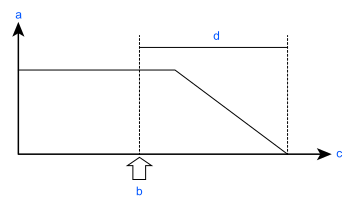
| Symbol | Description |
|---|---|
| a | Motor speed |
| b | Emergency stop, Maximum Speed of SLS exceeded, monitoring areas and Joint Angle Limit of SLP exceeded, restricted range of Soft Axis Limiting exceeded |
| c | Time |
| d | Stopping Time |
Condition:
The stopping time and stopping distance depend on the parameters (setting values) that were set for the robot. These graphs show the time and distance for the following parameters.
These conditions are based on the ISO 10218-1:2011 Annex B.
- Accel: 100, 100
- Speed: 100 %, 66 %, 33 % Settings
- Weight: 100 %, 66 %, 33 % of the maximum payload, rated payload
- Arm elongation rate: 100% 66%, 33% *1
- Other: Default
- Motion: Singular axis of a Go command
- Input timing of the Stop signal: Input with maximum speed. In this motion, it is the center of the motion range.
*1 The arm elongation rate when J1 is operating: Arm elongation rate 0 is as shown in the figure below.
The graphs indicate the results where the stopping time and the stopping distance in the longest among the following arm elongation rate.
When J2 is operating, J3 is 0 mm.
| Axis | θ = 100% | θ = 66% | θ = 33% |
|---|---|---|---|
| J1 | 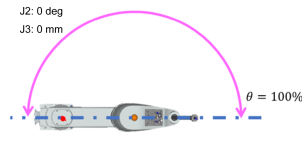 | 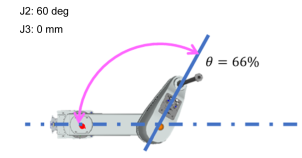 | 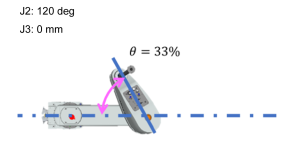 |
Explanation of legend
The graphs are displayed for each Weight setting value (at 100%, approx. 66%, and approx. 33% of the maximum payload, and at the rated payload).
- Horizontal axis: Arm speed (Speed value)
- Vertical axis: Stopping time and stopping distance in each arm speed
- Time (sec): Stopping time (sec)
- Distance (deg): J1 and J2 stopping distance (degree)
- Distance [mm]: Stopping distance of J3
When single failures are taken into account, the following adjustments are used.
- Stopping distance and angle: Each axis reaches the mechanical stop
- Stopping time: Add 500 ms