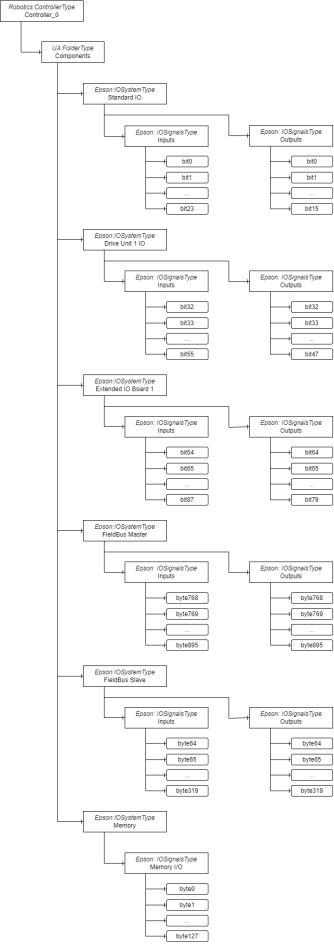
Specification of I/O Node
All I/O including Out port are Read-only in this system.
I/O Port
Following shows supported I/O port.
| I/O Type | Prior to 8.0.0 | 8.0.0 or later |
|---|---|---|
| Standard I/O | ✓ | ✓ |
| Extended I/O | ✓ | ✓ |
| Fieldbus Slave I/O | ✓ | |
| Fieldbus Master I/O | ✓ | |
| Memory I/O | ✓ | |
| Drive Unit I/O | ✓ |
Relation of CS Robotics Part1
I/O node is placed as the one of [ComponentIdentifier] under the Components node on address space of CS Robotics Part1 Ver.1.00.
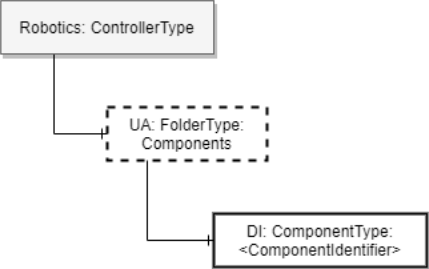
IOSystemType ObjectType Definition
Overview
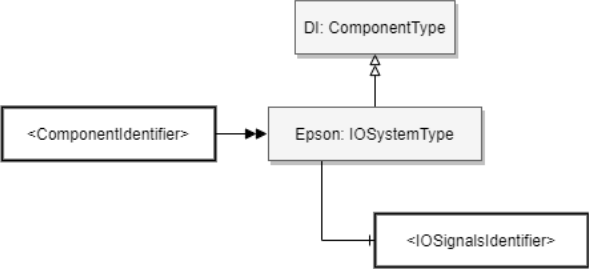
IOSystemType indicates I/O system installed in the Controller.
Instancing this type for each type of I/O system installed in the Controller.
ObjectType Definition
Following shows definition of IOSystemType.
| Attribute | Value |
|---|---|
| BrowseName | IOSystemType |
| IsAbstract | FALSE |
| References | Node Class | BrowseName | DataType | TypeDefinition | Modelling Rule |
|---|---|---|---|---|---|
| Subtype of the ComponentType defined in OPC Unified Architecture for Devices (DI) | |||||
| HasComponent | Object | [IOSignalsIdentifier] | - | Epson: IOSignalsType | MandatoryPlaceholder |
ObjectType Description
Object [IOSignalsIdentifier]
[IOSignalsIdentifier] indicates I/O system is including more than one I/O port and indicated by IOSignalsType instance.
IOSignalsType ObjectType Definition
Overview
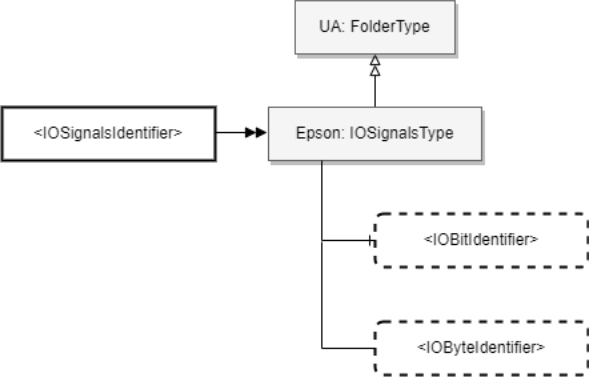
IOSignalsType indicates I/O port including multiple I/O signals, and it functions as a container of Variable node indicating I/O signals. Instancing this Type for each type of I/O signal such as In/Out.
ObjectType Definition
Following shows definition of IOSignalsType.
| Attribute | Value |
|---|---|
| BrowseName | IOSignalsType |
| IsAbstract | FALSE |
| References | Node Class | BrowseName | DataType | TypeDefinition | Modelling Rule |
|---|---|---|---|---|---|
| Subtype of the FolderType defined in OPC Unified Architecture | |||||
| HasComponent | Variable | [IOBitIdentifier] | Boolean | BaseDataVariableType | OptionalPlaceholder |
| HasComponent | Variable | [IOByteIdentifier] | Byte | BaseDataVariableType | OptionalPlaceholder |
ObjectType Description
Variable [IOBitIdentifier]
[IOBitIdentifier] indicates I/O port is including multiple I/O signals, and there are this Variable node exists for each bit of the I/O signal.
Value=TRUE means I/O signal is ON, FALSE means I/O signal is OFF.
Variable [IOByteIdentifier]
[IOByteIdentifier], like [IOBitIdentifier], indicates that the I/O port includes multiple I/O signals. This variable node exists for each byte of the I/O signal. When the Value is converted into a binary bit string, the port of the number(0~) of the bit that becomes 1 means ON in the I/0 signal, and the port of the number of the bit that becomes 0 means OFF in the I/O signal.
Variable [IOWordIdentifier]
[IOByteIdentifier], like [IOByteIdentifier] and [IOBitIdentifier], indicates that the I/O port includes multiple I/O signals. This variable node exists for each word of the I/O signal. When the Value is converted into a binary bit string, the port of the number(0~) of the bit that becomes 1 means ON in the I/O signal, and the port of the number of the bit that becomes 0 means OFF in the I/O signal.
Examples of Address Space
Following the definitions of the nodes described above, examples of address spaces whose nodes have been instanced are as follows: