Setting the Mechanical Stop of Joint #3
This work should be performed by people who have received installation and maintenance training provided by Epson or its suppliers.
KEY POINTS
For RS6-C552C, the motion range cannot be set using the mechanical stop of Joint #3.
Turn on the Controller, and turn off the motors using the Motor OFF statement.
For RS4-C, remove the Arm #2 cover. (4-M4 × 10)
Push up the shaft while pressing the brake release switch.
KEY POINTS
When you press the brake release switch, the shaft may lower due to the weight of the hand. Be sure to hold the shaft by hand while pressing the switch.
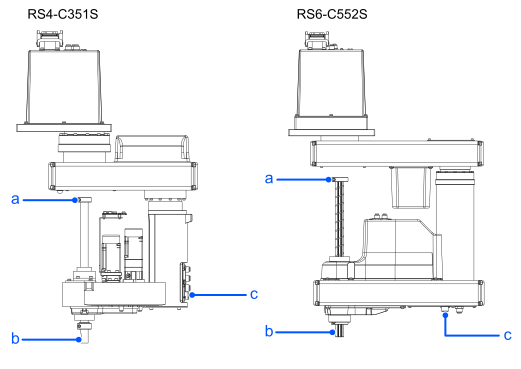
Symbol Description a Lower limit mechanical stop mounting screw (RS4-C: M3 × 10, RS6-C552S: M4 × 15) b Shaft c Brake release switch Turn off the Controller.
Loosen the lower limit mechanical stop screw (RS4-C: M3 × 10, RS6-C552S: M4 × 15).
KEY POINTS
A mechanical stop is mounted on both the top and bottom of Joint #3. However, only the position of the lower limit mechanical stop on the top can be changed. Do not remove the upper limit mechanical stop on the bottom because the origin position of Joint #3 is determined by this stop.
The upper end of the shaft defines the maximum stroke position. Move the lower limit mechanical stop down by the length that you want to limit the stroke.
For example, when the lower limit mechanical stop is set at the "130 mm" stroke, the lower limit Z coordinate value is "-130". To change this value to "-100", move the lower limit mechanical stop down by 30 mm. Use calipers or similar tool to measure the distance when adjusting the mechanical stop.RS4-C351S
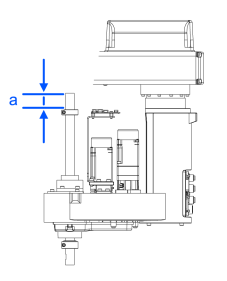
Symbol Description a Measurement length Firmly tighten the lower limit mechanical stop screw (M3 × 10).
Recommend tightening torque: 2.5±0.15 N・m (26±1.5 kgf・cm)
(The recommended tightening torque to use when tightening screws (M4 × 15) on the mechanical stop part of RS6-C: 5.0±0.25 N・m (51±2.5 kgf·cm))Turn on the Controller.
Press down Joint #3 while pressing the brake release switch, and then check the lower limit position. Do not lower the mechanical stop too far. Otherwise, the joint may not reach a target position.
Calculate the lower limit pulse value of the pulse range using the formula shown below, and set the value.
The result of the calculation is always negative because the lower limit Z coordinate value is negative.
Lower limit pulse value = (lower limit Z-coordinate value)/Joint #3 resolution** (mm/pulse)
** For details on the Joint #3 resolution, refer to the following section.
Appendix A: Specifications Table
Execute the following command in [Command Window]. Enter the value that you calculated for X.>JRANGE 3,X,0 'Sets the pulse range of Joint #3Using the Pulse statement (Go Pulse statement), move Joint #3 to the lower limit position of the pulse range that was set at low speed.
If the mechanical stop range is less than the pulse range, Joint #3 will hit the mechanical stop and an error will occur. When an error occurs, either change the pulse range to a narrower setting or extend the position of the mechanical stop within the limit.KEY POINTS
If it is difficult to check whether Joint #3 hits a mechanical stop, turn off the Controller and lift the arm top cover to check the situation from the side.
Execute the following command in [Command Window]. Enter the value calculated in Step (10) for X.>MOTOR ON 'Turns on the motor >SPEED 5 'Sets to low speed >PULSE 0,0,X,0 ''Moves to the lower limit pulse position of Joint #3(In this example, all pulses except those for Joint #3 are "0". Substitute these "0" values with the other pulse values to specify a position where interference will not occur even when lowering Joint #3.)