Base table
A base table for anchoring the Manipulator is not supplied. The base table must be fabricated or obtained by the customer.
The shape and size of the base table vary depending on the application of the robot system. As a reference when designing the base table, the requirements from the Manipulator side are shown here.
The base table must not only be able to bear the weight of the Manipulator but also be able to withstand the dynamic movement of the Manipulator when it operates at maximum acceleration. Ensure that there is enough strength on the base table by attaching reinforcing materials such as crossbeams.
The following are the torque and reaction force produced by the movement of the Manipulator.
| VT6-B901* | ||
|---|---|---|
| Max. torque on the horizontal plate | 360 | N·m |
| Max. Reaction fore on the horizontal direction | 670 | N |
| Maximum reaction force in vertical direction | 670 | N |
CAUTION
If vibration occurs, improve rigidity of the base table or lower the speed or acceleration and deceleration settings. If it is used when the vibration is strong, it may cause the connected parts to get loose and apply excessive load to mechanical parts, potentially shortening the lifespan.
The threaded holes required for mounting the Manipulator base are M8. Use mounting bolts conforming to the strength equivalent to ISO898-1 property class 10.9 or 12.9. For dimensions, refer to the following.
Manipulator Mounting Dimensions
The plate for the Manipulator mounting face should be at least 20 mm thick and made of steel for reducing vibrations. The surface roughness should be 25 μm or less.
The base table must be secured on the floor or wall to prevent it from moving.
The Manipulator’s installation surface should have a flatness of 0.5 mm or less and an inclination of 0.5° or less. If the installation surface does not have the proper flatness, the base of the Manipulator may be damaged or the robot may be unable to operate at maximum performance.
When mounting the Manipulator on a mobile platform, be sure to use a mobile platform in low acceleration. When the mobile platform is used in high acceleration, it may cause the Manipulator to make a safety stop.
Be sure to design the installation position of the Manipulator so that the center of gravity is always within the mobile platform when the Manipulator grasps a workpiece by using a tool. For operation pose, create an operation program so that the center of gravity of the Manipulator is always within the mobile platform. If the center of gravity is not within the mobile platform, the Manipulator may fall over.
When using a leveler to adjust the height of the base table, use a screw with M16 diameter or more.
If passing cables through the holes in the base table, refer to the connector dimensions in the figures below.
KEY POINTS
Adjust the holes of the base table with the shell size to be used.
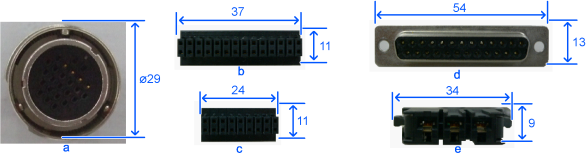
| Symbol | Description |
|---|---|
| a | TP connector |
| b | I/O (Input) Connector |
| c | I/O (Output) Connector |
| d | EMERGENCY Connector |
| e | AC power connector |
WARNING
To ensure safety, a safeguard must be installed for the robot system. For details on the safeguard, refer to the following: