Base table
A base table for anchoring the Manipulator must be fabricated by the customer.
The shape and size of the base table vary depending on the application of the robot system. As a reference when designing the base table, the requirements from the Manipulator side are shown here.
The base table must not only be able to bear the weight of the Manipulator but also be able to withstand the dynamic movement of the Manipulator when it operates at maximum acceleration/deceleration. Ensure that the base table has sufficient strength by using numerous reinforcing materials such as crossbeams.
The torque and reaction force produced by the movement of the Manipulator are as follows:
- Maximum torque on horizontal surface: 400 N · m (RS4-C351*), 700 N · m (RS6-C552*)
- Maximum reaction force in horizontal direction: 1100 N (RS4-C351*), 1900 N (RS6-C552*)
- Maximum reaction force in vertical direction: 1200 N (RS4-C351*), 1000 N (RS6-C552*)
CAUTION
If the vibration of the base table is large, reduce the acceleration/deceleration or increase the rigidity of the base table to reduce the vibration. Continued use in a state of large vibration may cause loosening of fastening parts or excessive load on mechanical parts, which may shorten the lifespan.
M6 threaded holes are used for mounting the Manipulator on the base table.
Use bolts for mounting the Manipulator that have a strength compliant with ISO 898-1 property class 10.9 or 12.9. For details on the dimensions, refer to the following sections.
Names of Parts and Their Dimensions
Manipulator Mounting Dimensions
The plate for the Manipulator mounting face should be at least 20 mm thick and made of steel for reducing vibrations. A surface roughness of 25 μm or less at the maximum height is appropriate.
The base table must be secured to the floor or wall to prevent it from moving.
The Manipulator mounting surface should have a flatness of 0.5 mm or less and an inclination of 0.5° or less. If the installation surface does not have the proper flatness, the base of the Manipulator may be damaged or the robot may be unable to operate at maximum performance.
When using a leveler to adjust the height of the base table, use a screw with an M16 diameter or more.
If passing cables through the holes in the base table, refer to the connector dimensions in the figures below.
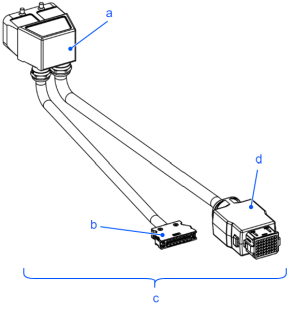
| Symbol | Description |
|---|---|
| a | M/C cable hood |
| b | Signal connector |
| c | M/C power cable |
| d | Power connector |
| Signal Connector | Power Connector (Straight) | Power Connector (L-shaped) |
|---|---|---|
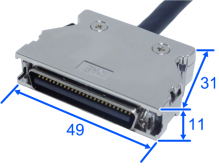 | 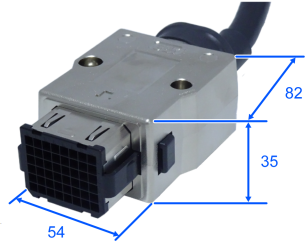 | 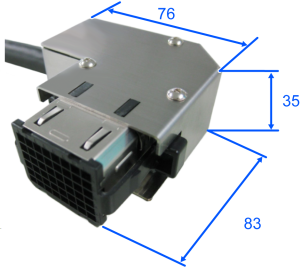 |
(Unit: mm)
The M/C cables are attached to the Manipulator. They cannot be removed. Do not forcibly remove them.
If a maintenance window cannot be installed on the base table, then the Manipulator must be removed from the base table when performing maintenance. When designing the base table, take into consideration the ease of maintenance.
For details on the environmental requirements for the space when housing the Controller in the base table, refer to the following manual.
"Controller Manual"
WARNING
- To ensure safety, be sure to install safety barriers for the robot system. For details, refer to the following section.
Safeguard (SG)
Example base table design
The following is a design example of a base table that ensures rigidity so as not to affect the vibration of the RS4-C when the RS4-C is moved at its maximum acceleration and deceleration.
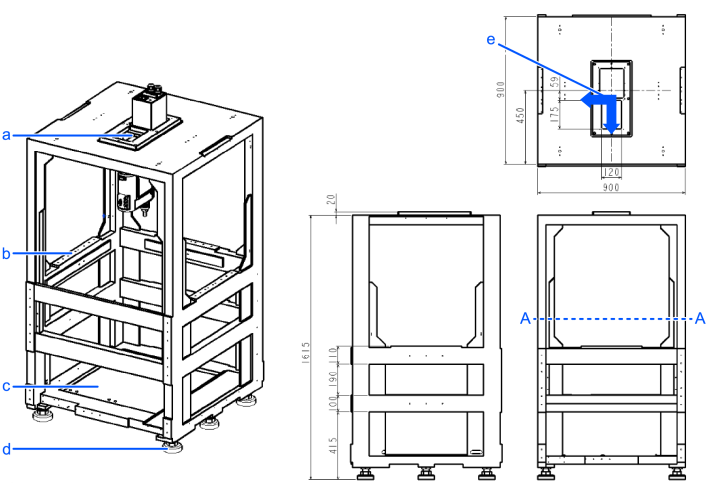
| Symbol | Description |
|---|---|
| a | Maintenance window * |
| b | Operating surface height |
| c | Space for Controller installation |
| d | Adjuster bolt |
| e | Rotation center of Joint #1 |
*: Space must be provided to remove the cover of Arm #1
Base table weight: Approx. 300 kg
Frame material: Steel pipe square, 100 × 50 mm, thickness: 3.2 mm
Adjuster bolt : M36
Second moment of area (cross-section view of A-A): Ix = 1.2 × 109 mm4
Iy = 1.2 × 109 mm4
- Use a small aspect ratio of the base table height and width.
- The Controller and other equipment should be installed on the bottom of the base table to lower the center of gravity of the base table.
- Openings should be reinforced with crossbeams or the like and made as small as possible.
- Conditions vary depending on the height and width of the base table, the position of the crossbeams, the center of gravity, and other factors.
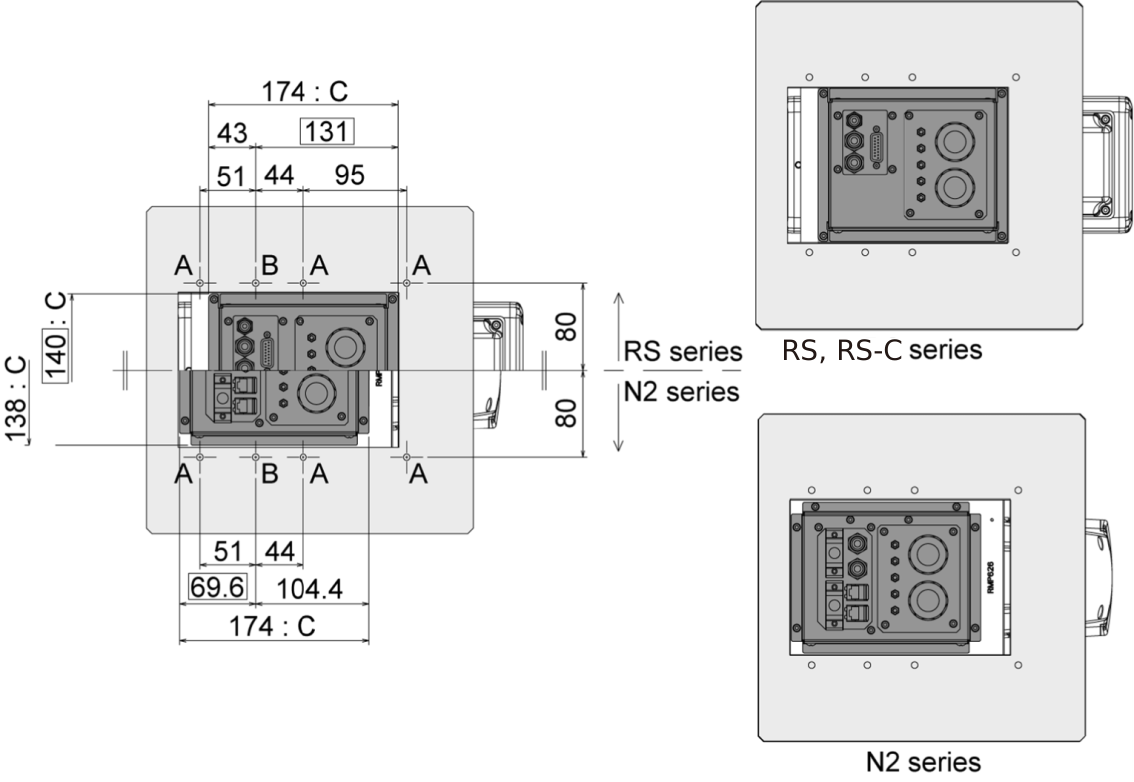
Example of space for base
This is an example of space for a base to allow installation of either the RS, RS-C or N2 series.
Design the base table as shown below to the extent that it does not interfere with the positioning holes or mounting holes.
Height: 140 mm or more.
Width: 131 mm or more and 69.6 mm or more from the reference hole.
(Units: mm)
| Symbol | Description |
|---|---|
| A | Hole for mounting |
| B | Positioning hole |
| C | Manipulator cover exterior |